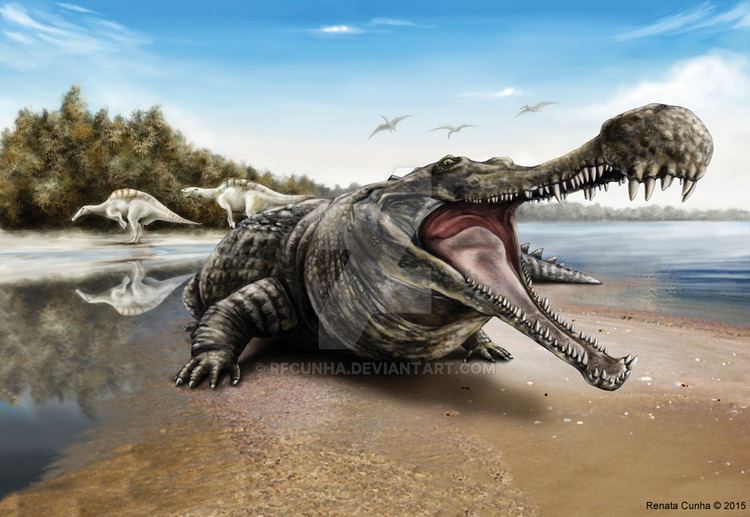
Sarcosuchus was by far the biggest crocodile that ever lived, making modern crocs,caimans,and gators look like insignificant geckos by comparison. Below are 8 interesting Facts About Sarcosuchus.
Sarcosuchus Is Also Known as the SuperCroc

A view from tail to snapping jaws of aSarcosuchusskeleton.
The name Sarcosuchus is Greek for flesh crocodile, but that apparently wasnt impressive enough for the producers at National Geographic. In 2001, this cable channel bestowed the title SuperCroc on its hour-long documentary about Sarcosuchus , a name that has since stuck in the popular imagination. (By the way, there are other -crocs in the prehistoric bestiary, none of which are quite as popular as SuperCroc: for example, have you ever heard of the BoarCroc or the DuckCroc ?)
Sarcosuchus Kept Growing Throughout Its Life Span

A digital image of a Sarcosuchus with a sheen of green moss on its reptilian skin.
Unlike modern crocodiles, which attain their full adult size in about 10 years, Sarcosuchus seems to have kept growing and growing at a steady rate throughout its lifetime (paleontologists can determine this by examining bone cross-sections from variousfossilized specimens). As a result, the largest, most superannuated SuperCrocs reached lengths of up to 40 feet from head to tail, compared to about 25 feet max for the biggest croc alive today, the saltwater crocodile.
Sarcosuchus Adults May Have Weighed More Than 10 Tons

             Sarcosuchus model on display at the

              French National Museum

             of Natural History.
What made Sarcosuchus truly impressive was its dinosaur-worthy weight: more than 10 tons for those 40-foot-long senior citizens described in the previous slide, and perhaps seven or eight tons for the average adult. If the SuperCroc had lived after the dinosaurs had gone extinct, rather than right alongside them during the middle Cretaceous period (about 100 million years ago), it would have counted as one of the largest land-dwelling animals on the face of the Earth.
Sarcosuchus May Have Tangled With Spinosaurus

Head of Sarcosuchus on the left and skeleton of Spinosaurus on the right.
Although its unlikely that Sarcosuchus deliberately hunted dinosaurs for lunch, theres no reason it had to tolerate other predators that competed with it for limited food resources. A full-grown SuperCroc would have been more than capable of breaking the neck of a large theropod, such as, say, the contemporary, fish-eating Spinosaurus , the largest meat-eating dinosaur that ever lived. While its an undocumented encounter, its an interesting one to think about: Spinosaurus vs. Sarcosuchus Who Wins?
Extremely interesting Sarcosuchus Facts
The Eyes of Sarcosuchus Rolled Up and Down, not Left and Right

Skeletal head of Sarcosuchus.
You can tell a lot about an animals accustomed behavior by observing the shape, structure, and placement of its eyes. The eyes of Sarcosuchus didnt move left and right, like those of a cow or panther, but rather up and down, indicating that the SuperCroc spent much of its time submerged partway below the surface of freshwater rivers (like modern crocodiles), scanning the banks for interlopers and occasionally breaching the surface to snap at encroaching dinosaurs and drag them into the water.
Sarcosuchus Lived Where the Sahara Desert Now Lies

One hundred million years ago, northern Africa was a lush, tropical region crisscrossed by numerous rivers; it has only been relatively recently (geologically speaking) that this area dried out and became overspread by theSahara, the largest desert in the world. Sarcosuchus was only one of a wide variety of plus-sized reptiles that took advantage of this regions natural abundance during the later Mesozoic Era, basking in its year-round heat and humidity; there were also plenty of dinosaurs to keep this croc company.
Sarcosuchus Mostly Subsisted on Fish

Youd think a crocodile as big and heavy as Sarcosuchus would have feasted exclusively on the plus-sized dinosaurs of its habitatsay, half-tonhadrosaursthat wandered too close to the river for a drink. Judging by the length and shape of its snout, though, its likely that the SuperCroc ate fish pretty much exclusively (gigantic theropods equipped with similar snouts, like Spinosaurus , also enjoyed piscivorous diets), only feasting on dinosaurs when the opportunity was too good to pass up.
Sarcosuchus Was Technically a Pholidosaur

Its catchy nickname aside, the SuperCroc wasnt a direct ancestor of modern crocodiles, but rather an obscure type of prehistoric reptile known as a pholidosaur. (By contrast, the almost-as-big Deinosuchus was a genuine member of the crocodile family, though it has technically been classified as an alligator.) The crocodile-like pholidosaurs went extinct millions of years ago for reasons that are still uncertain and havent left any direct living descendants.
Also read: 10 Scary Prehistoric Animals That Werent Dinosaurs