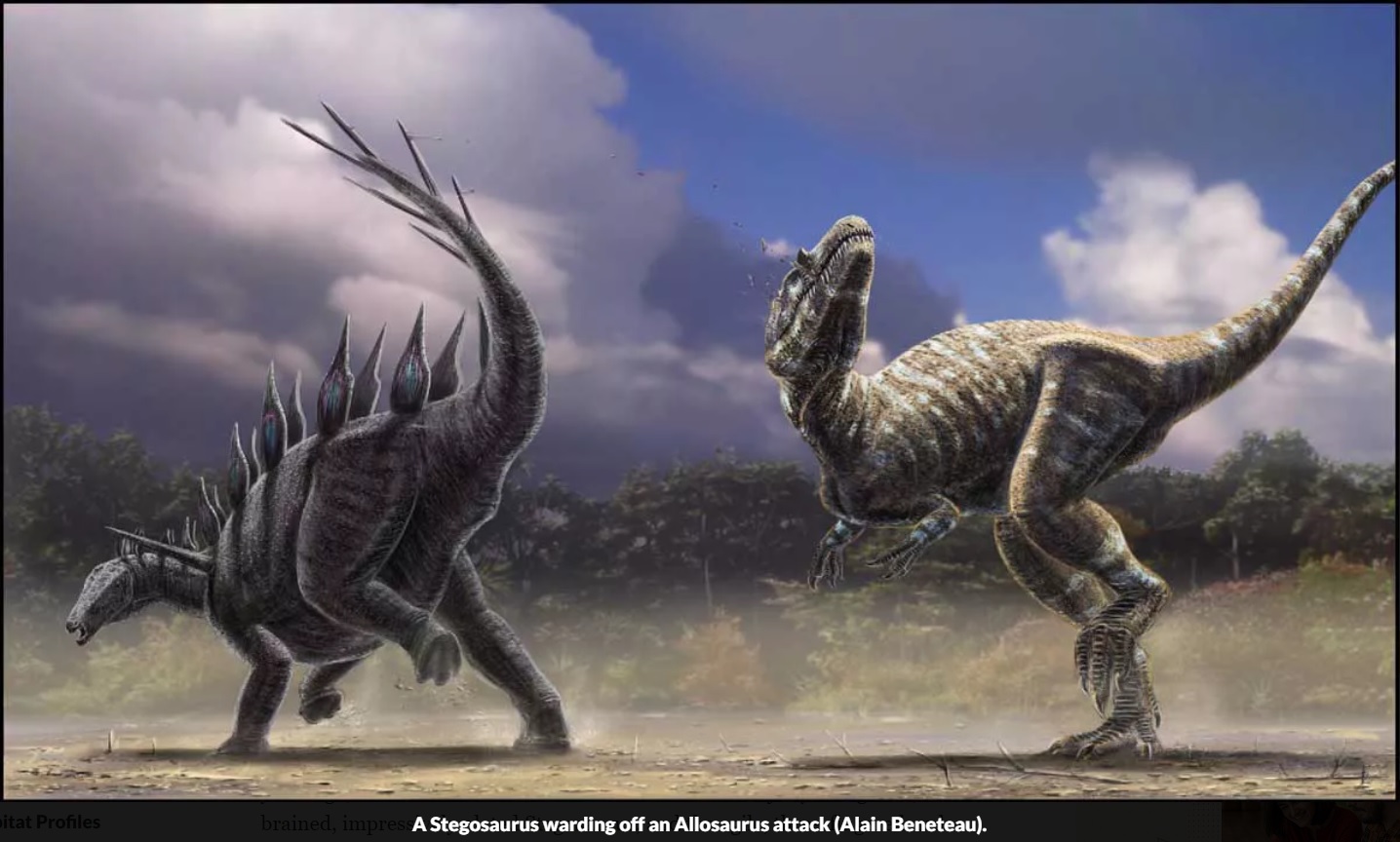
Allosaurus vs. Stegosaurus
Across the plains and woodlands of late Jurassic North America, circa 150 million years ago, two dinosaurs stood out for their size and majesty: the gentle, small-brained, impressively plated Stegosaurus, and the agile, three-fingered and perpetually hungry Allosaurus. Before these dinosaurs take their corners in the Dinosaur Death Duel thunderdome, lets look at their specs. (See more Dinosaur Death Duels.)
In the Near Corner Stegosaurus, the Spiked, Plated Dinosaur
About 30 feet long from head to tail and weighing in the neighborhood of two to three tons, Stegosaurus was built like a Jurassic tank. Not only did this plant-eater sport two rows of roughly triangular bony plates lining its back and neck, but its skin was extremely tough (and probably much harder to bite through than the epidermis of an elephant). this dinosaurs name, roofed lizard, was bestowed before paleontologists properly understood the orientation of its famous scutes, or bony plates (and even today, theres some controversy aboutwhat these plates were actually intended for).
Advantages . In close combat, Stegosaurus could rely on its spiked tailsometimes calleda thagomizerto deter hungry theropods. We dont know how fast the average Stegosaurus couldswing this deadly weapon, but even a glancing blow might well have taken out an unlucky theropods eye, or inflicted some other nasty wound that would convince it to go after easier prey. The squat build of Stegosaurus, and its low center of gravity, also made this dinosaur difficult to dislodge from an advantageous position.
Disadvantages . Stegosaurus is the genus everyone has in mind when they talk about how spectacularly dumb dinosaurs were. This hippopotamus-size herbivore only possessed a brain the size of a walnut, so theres now way it could outsmart a nimble theropod like Allosaurus (or even a giant fern, for that matter). Stegosaurus was alsoconsiderably slowerthan Allosaurus, thanks to its low-to-the-ground build and much shorter legs. As for its plates, they would have been virtually useless in combatunless these structures evolved to make Stegosaurus look much bigger than it actually was, and thus prevent a fight in the first place.
In the Far Corner Allosaurus, the Jurassic Killing Machine
Pound for pound, if were speaking literally, a full-grown Allosaurus would be almost an even match for an adult Stegosaurus. The largest specimens of this two-legged killing machine measured about 40 feet from head to tail and weighed about two tons. Like Stegosaurus, Allosaurus has a slightly deceptive nameGreek for different lizard, which didnt impart much information to early paleontologists save for the fact that it was an entirely different dinosaur from the closely related Megalosaurus.
Advantages . The deadliest weapon in Allosaurus armory was its teeth. This theropods plentiful choppers attainedlengths of three or four inches, and were continually growing, and being shed, during its lifetimemeaning they were more likely than not to be razor-sharp and ready for the kill. We dont know quite how fast Allosaurus was able to run , but its a sure bet that it was speedier than the plodding, walnut-brained Stegosaurus. And lets not forget those grasping, three-fingered hands, a more nimble implement than anything in Stegosaurus armory.
Disadvantages . As fearsome as it was, theres no evidence that Allosaurus ever got the hang of hunting in packs, which would have been of considerable advantage when attempting to take down a plant-eating dinosaur the size of a Sherman tank. Its also unlikely that Allosaurus could do much with its relatively puny arms (as opposed to its hands), which were still, however, much deadlier than the near-vestigial appendages of the much later Tyrannosaurus Rex . And then theres the matter of weight class; although the largest Allosaurus individuals might have approached Stegosaurus in bulk, most adults weighed only one or two tons, max.
Fight!
Lets say our full-grown Allosaurus happens upon the Stegosaurus while the latter dinosaur is busy feeding on low, tasty shrubs. Allosaurus lowers its neck, builds up a head of steam, and butts the Stegosaurus in the flank with its big, bony head, imparting countless megajoules of momentum. Startled, but not quite toppled, the Stegosaurus lashes out with the thagomizer on the end its tail, inflicting only superficial wounds on Allosaurus hind legs; at the same time, it crouches closer to the ground, so as not to expose its soft underbelly to a well-delivered bite. Undeterred, Allosaurus charges again, lowers its massive head, and this time succeeds in flipping the Stegosaurus onto its side.
And the Winner Is
Allosaurus! Once dislodged from its defensive position, the slow-wittedStegosaurusis nearly as helpless as a flipped turtle, uselessly thrashing its head and its thagomizer and bellowing to other members of the herd. A modern tiger would mercifully bite its prey in the neck and end its misery, but Allosaurus, unencumbered by any sort of Jurassic conscience, digs into Stegosaurus belly and begins eating its entrails while its victim is still alive. Other hungry theropods, including small, feathereddino-birds, cluster around the scene, eager for a taste of the kill but sensible enough to let the much bigger Allosaurus have its fill first.


