
https://paleontology.us Everything on Paleontology, curiosities, facts, etc... Wed, 29 Jul 2020 09:03:24 +0000 en-US hourly 1 https://wordpress.org/?v=5.5.3 https://paleontology.us/wp-content/uploads/2019/10/cropped-logo-32x32.jpg
https://paleontology.us 32 32
https://paleontology.us/marine-and-aquatic-dinosaurs/ Paleontology_US Tue, 21 Jul 2020 10:32:14 +0000 Entertainment Facts Prehistoric Creatures https://paleontology.us/?p=1596 Marine and aquatic dinosaurs Ichthyosaur Period: This species lived during the Jurassic period, between 200 and 190 million years ago. Location: Based on fossil findings, it has been determined that the species inhabited various parts of the oceans worldwide. Diet: Carnivore. Length: 1.83 meters. Weight: Between 81 and 92 kilograms. The Ichthyosaur, whose name means […]
Period: This species lived during the Jurassic period, between 200 and 190 million years ago.
Location: Based on fossil findings, it has been determined that the species inhabited various parts of the oceans worldwide.
Diet: Carnivore.
Length: 1.83 meters.
Weight: Between 81 and 92 kilograms.
The Ichthyosaur, whose name means fish lizard, was an aquatic reptile that inhabited the Earth’s oceans in the Jurassic, between 190 and 200 million years ago.
From the study of their fossils it has been determined that a specimen could grow up to 1.83 meters high, and weigh up to 92 kilograms. Due to its physical appearance, due to the existing similarities, it could be thought that the ichthyosaur was the ancestor of modern dolphins. The bones of his ears and eyes were large, which inclined to think that he had great acuity in both directions.
Likewise, its anatomy presumably allowed it to reach swimming speeds of up to 40 kilometers per hour and capture the species that made up its carnivorous diet, mainly fish.
The finding of some fossils with young inside inclines to think that the ichthyosaur did not lay eggs like other reptiles, but gave birth to its descendants.
Period: Mid Triassic period, between 235 and 225 million years ago.
Location: Various parts of Europe, from the discovery of fossils.
Diet : Carnivore.
Length: 1.83 meters.
Weight: between 23 and 32 kilograms.

Askeptosaurus inhabited European waters during the Triassic period , approximately 220 million years ago. It was part of a family of diapsid reptiles, called Thalattosaurus.
The main fossil finds have occurred in European countries such as Italy and Switzerland, although this does not rule out that in addition to Europe they have entered other waters.
The Askeptosaurus was very similar in its habits and routines to the aquatic reptiles of today. They were mostly submerged in water and dabbled in land only to lay their eggs.
As for his physique, he was slender in build, with a long neck, body, and tail, suggesting that he might move in the water just as eels do, and that he could dive to great depths to catch fish and other species. members of their carnivorous diet.
Period: End of the Cretaceous period (70 million years ago).
Location: Oceans around the world.
Diet: Carnivore.
Length: 13.72 meters.
Weight: From two thousand to three thousand kilograms.

This species, whose name means “tape lizard”, swam in oceans around the world during the Cretaceous period, approximately 70 million years ago.
It was part of the Elasmosauridae family, made up of very long-necked marine reptiles. Estimates show that Elasmosaurus specimens could reach a length of 13.72 meters and weigh between two and three thousand kilograms.
As distinctive features of the animal’s anatomy or constitution, the 71 cervical vertebrae of its neck, its slightly flat skull, its long conical teeth, its oar-shaped fins and its short tail can be pointed out; all useful attributes for swimming and fishing of minor species, members of their carnivorous diet.
Period: Between 28 and 2 million years ago, between the Oligocene and the Pleistocene
Fossil locations: In all oceans
Approximate length: Between 14 and 20 meters
Approximate weight: 50 tons
Diet: Carnivore

We find one of the shark species that lived the longest in the seas, something that was achieved thanks to its physical strength, its ability to adapt and, of course, a murderous instinct that made it one of the most lethal prehistoric predators that they were in the sea. It inhabited the seas and oceans in the Conozoic Era , around 2.6 million years ago, having its name with a meaning that completely defined it. The megalodon means “big tooth” since its teeth could measure around 20 centimeters and were made to devour and destroy its victims. It has been found that it has a structure of teeth very similar to that of the white shark and during its life it detaches from its teeth, reborn new ones with more force. If we compare the bite of the Megalodon with that of the Tyrannosaurus Rex, we can verify that that of this marine animal is up to 5 times stronger than that of the reptile, being able to feed on practically any animal. Its extinction is related to the lack of prehistoric whales, which confirmed its main source of food, and since these did not exist, the megalodons were extinguishing.
Period: 162 to 144 million years ago, in the Jurassic
Fossil locations: France
Approximate length: 30 meters
Approximate weight: 75-150 Tons
Diet: Carnivore

If you want to find one of the largest carnivorous animals on Earth, you would have to look back about 165 million years to find the Liopleurodon which was capable of measuring more than 30 meters and weighing up to 150 tons. It is an aquatic dinosaur that rivaled other animals, and it was the terror of the seas since, in addition to having a large mouth with sharp teeth, it was able to move nimbly underwater, turning and propelling itself towards its prey, something that gave them little choice in life. This size and ease of hunting ensured that even the fiercest predators were included as a diet in their daily diet. It is an animal that had to eat constantly, so when it began to run short of prey of the size necessary for its survival, it began to become extinct.
Period : Between 125 and 97 million years ago, in the lower and upper Cretaceous
Fossil locations: Australia and South America
Approximate length: 10.5 meters
Approximate weight: 12 tons
Diet: Carnivore

The name of this great lizard came from the god Kronos and during the Middle Cretaceous (that is to say 110 million years ago) it was found in the seas of Earth. It is said that it may be a very distant relative of the crocodiles since they are very similar both in the length of their bodies and in their jaws. The length of its body was about 10 meters, although much higher specimens have been found. His head was very strong and powerful, something that was appreciated in his jaws that he used to catch and break the bones of his prey. As a curious fact, these reptiles have been found fossilized with many stones in their stomach, which suggests that the Kronosaurus ingested stones or to grind the food they had just taken and in this way make their digestion easier, or to help them to dive, acting as a counterweight. These animals, despite being almost all their lives in the sea, went to dry land to lay their eggs, something that current sea turtles also do.
Period: Miocene, 15 million years ago.
Fossil locations: Peru
Approximate length: 17.5 meters
Approximate weight: 30 tons
Diet: Carnivore

We find a species that has been discovered very recently and that dates back to at least 15 million years ago. The Livyatan is closely related to the whales, at least in similarity and they lived what in their time would be South America. It was an animal that reached 20 meters in length and was very fierce and aggressive. His teeth are one of the largest on record, at about 36 centimetres long, he was able to tear apart any meat. Its head or nose is very flat, reaching the same level as the mouth, with hard and resistant bones, which suggests that it used this part of its body so much to hit its prey, leaving them wounded and then devouring them or even when fighting with other males of its species to get to mate. In the case of having to face a large prey, all went together towards it, causing great damage, so those that did not die on the spot, did so later.
Period: Between 368 and 359 million years ago, in the Upper Devonian
Fossil locations: North America, Europe and Africa
Approximate length: 10 meters
Approximate weight: 6 tons
Diet: Carnivore

The Dunkleosteus was one of the armored fish that lived more than 350 million years ago and had a body covered with large bone plates that it used to defend itself against other predators, although they are also known as animals that practiced cannibalism, with an aspect very close to the piranhas that today inhabit our waters. Its fins were short and very close to the body, with the exception of the tail, being able to measure this more than a meter, using it to move at high speed with each movement. One of the most characteristic features of these animals is that they did not have teeth as we can identify them, but that it was a hard and very sharp bone that did this and covered the entire jaw. They were very aggressive animals, although they used to be in groups, when one bothered another they could end up fighting or devoured by themselves.
Period: Between 155.7 and 147 million years ago, in the Upper Jurassic
Fossil locations: Everyone
Approximate length: Between 10 and 15 meters
Approximate weight: Between 8 and 12 tons
Diet: Carnivore

This has been one of the marine dinosaurs that has taken the longest to discover, having several names before choosing Pliosaurus. When their fossils were found in an arctic region, it was not known which animal they were facing, so it was called Predator X. It is a marine reptile that inhabited in the Jurassic era and that thanks to its ferocity could feeding on countless animals, even those that could be larger, since their movements were fast and their body, being relatively slimmer, could also maneuver better to escape the attacks of their prey. Its head was long and could feed on other reptiles and fish. Its bite strength has been found to be much greater than that of the T-Rex , which is why few dinosaurs came out alive after being bitten by this sea beast.
Period: About 400 million years ago, in the Lower Devonian
Fossil locations: Germany
Approximate length: 3 meters
Approximate weight: 180 kilos
Diet: Carnivore
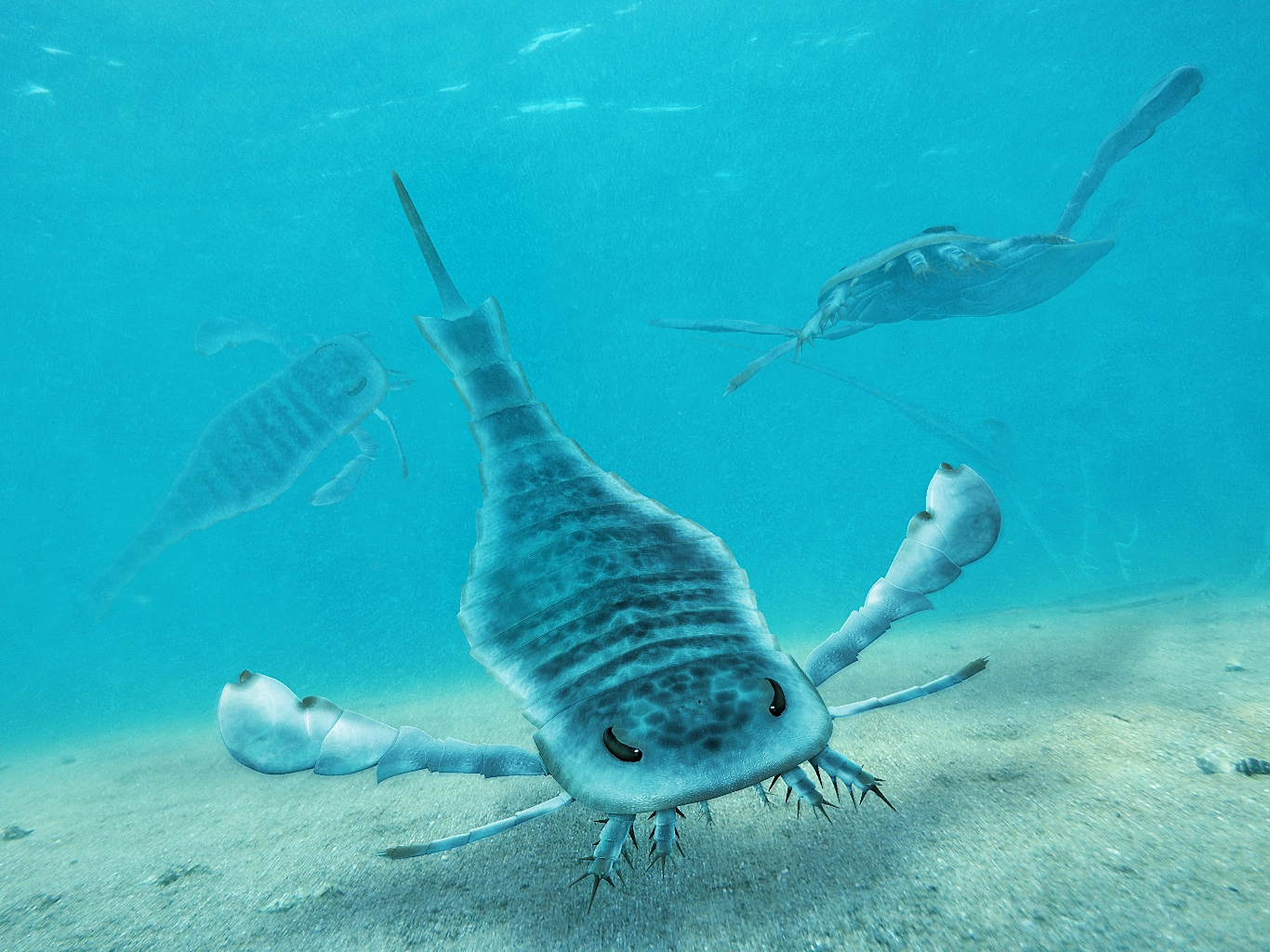
Although its scientific and technical name is Eurypterida, it is commonly known by the sea scorpion. It is called this way because it had a sting that it used to hunt and paralyze its prey, and could then feed on them. Its approximate size is about 3 meters, being able to feed on various fish and animals with ease. Although what is known about these prehistoric marine animals is that they lived in the oceans, it is known that they ended up climbing through the mouths of rivers, they reached marshes and other lakes where their size was decreasing over the years.
Also read: 10 Scary Prehistoric Animals – That Weren’t Dinosaurs
https://paleontology.us/anhanguera/ Paleontology_US Mon, 15 Jun 2020 11:15:59 +0000 Prehistoric Creatures https://paleontology.us/?p=1481 Anhanguera Anhanguera was a pterosaur, a type of flying reptile. It was not a dinosaur, though it lived during the same period. Anhanguera lived during the Early Cretaceous and resided in South America. The first Anhanguera fossil was discovered in 1985. Anhanguera Facts Lived during the Early Cretaceous Period Lived in what is now known as South America and Australia Was […]
Anhanguera was a pterosaur, a type of flying reptile. It was not a dinosaur , though it lived during the same period. Anhanguera lived during the Early Cretaceous and resided in South America. The first Anhanguera fossil was discovered in 1985.

Anhanguera is a pterosaur which lived approximately 125 million to 115 million years ago during the Early Cretaceous Period. It was first discovered during the 1980s and was named in 1985. Its name means “old devil” in Portuguese.
This is one flying reptile that you may not recognize from Anhanguera pictures. That’s because this pterosaur was discovered relatively recently – as compared to other flying reptiles – and doesn’t get the media attention that pterodactyls do. Which is quite a shame because this was one remarkable creature.
Anhanguera was approximately 4 feet tall, weighed around 50 pounds and had a wingspan of about 15 feet. That means its wingspan was about 3 times larger than a Crowned Eagle and its weight was about 12 times heavier than a Red-tailed Hawk. It had crests not only on top of its beak but also on the bottom.
One of the most interesting facts about Anhanguera is that it had relatively weak legs. Which means that it probably spent the majority of its time flying. If it did spend any time whatsoever on the ground, then it most likely walked with a very unusual gait and probably was a little wobbly.
Most paleontologists believe that this pterosaur used its beak to scoop up fish, but it is also possible that it hunted for carrion from dead animals that it discovered on land as well. It may have also eaten a variety of different insects as well. Which means that it may have had one of the most diverse diets of any flying reptiles of its time.
Also read: 8 Facts About Sarcosuchus – World’s Biggest Crocodile
https://paleontology.us/archelon/ Paleontology_US Mon, 01 Jun 2020 15:39:33 +0000 Prehistoric Creatures https://paleontology.us/?p=1410 Archelon Archelon is an extinct marine turtle from the Late Cretaceous, and is the largest turtle ever to have been documented, with the biggest specimen measuring 460 cm (15 ft) from head to tail, 400 cm (13 ft) from flipper to flipper, and 2,200 kg (4,900 lb) in weight. It is known only from the […]
Archelon is an extinct marine turtle from the Late Cretaceous , and is the largest turtle ever to have been documented, with the biggest specimen measuring 460 cm (15 ft) from head to tail, 400 cm (13 ft) from flipper to flipper, and 2,200 kg (4,900 lb) in weight. It is known only from the Dakota Pierre Shale and has one species, A. ischyros. In the past, the genus also contained A. marshii and A. copei, though these have been reassigned to Protostega and Microstega, respectively. The genus was named in 1895 by American paleontologist George Reber Wieland based on a skeleton from South Dakota, who placed it into the extinct family Protostegidae. The leatherback sea turtle (Dermochelys coriacea) was once thought to be its closest living relative, but now, Protostegidae is thought to be a completely separate lineage from any living sea turtle.
Archelon is an extinct sea turtle which lived approximately 75 million to 65 million years ago during the Late Cretaceous Period. It was first discovered in 1895 by Dr. G.R.Wieland in South Dakota. In 1896, he would go on and name it Archelon – a name which means “ruling turtle.”
If you were to merely look at Archelon pictures and nothing else, then you would assume this turtle was a normal sized sea turtle. However, that is far from the case. An average sea turtle is about 7 feet long and weighs around 350 pounds. Archelon, on the other hand, was 12 feet long and weighed around 2 tons – or about 4,000 pounds. That made it about the length of a small great white shark but much, much heavier.
One of the most interesting facts about Tetrapodophis is not its great size but its shell. This turtle didn’t have the same kind of hard shell that modern turtles do today. No, it had either bony plates or a leather-like covering that stretched over a framework of bones on its back. If it would’ve had a hard shell, then it most likely wouldn’t have been able to stay afloat while swimming in the ocean.
Archelon also had flipper-like arms that allowed it to move through the water fairly quickly. Which would’ve been needed considering the kinds of animals it was sharing the ocean with at the time. During this time, Archelon would have had to compete with, and occasionally swim very quickly away from, animals such as Tylosaurus and Cretoxyrhina.
What are some of the things that Archelon ate? Well, more than likely this turtle lived on the plentiful squids and jellyfish which inhabited the waters around North America at that time. It may have also eaten small fish that crossed its path.
Paleontologists believe that Archelon probably had a long lifespan, much like modern turtles do today. Scientists believe that it probably lived around 100 years – on average. They may have lived even longer than that.


https://paleontology.us/megalodon-facts-and-info-about-the-long-gone-giant-shark/ Paleontology_US Sun, 31 May 2020 01:04:56 +0000 Prehistoric Creatures https://paleontology.us/?p=1402 Megalodon Megalodon (Carcharocles megalodon), meaning “big tooth”, is an extinct species of shark that lived approximately 23 to 3.6 million years ago (mya), during the Early Miocene to the Pliocene. It was formerly thought to be a member of the family Lamnidae and a close relative of the great white shark (Carcharodon carcharias). However, it […]
Megalodon (Carcharocles megalodon), meaning “big tooth”, is an extinct species of shark that lived approximately 23 to 3.6 million years ago (mya), during the Early Miocene to the Pliocene. It was formerly thought to be a member of the family Lamnidae and a close relative of the great white shark (Carcharodon carcharias). However, it is now classified into the extinct family Otodontidae, which diverged from the great white shark during the Early Cretaceous.
The megalodon, which went extinct millions of years ago, was the largest shark ever to prowl the oceans and one of the largest fish on record. The scientific name, Carcharocles megalodon, means “giant tooth,” and for good reason: Its massive teeth are almost three times larger than the teeth of a modern great white shark. The megalodon’s fossilized bones and teeth give scientists major clues about what the creature was like and when it died off.
While the popular 2018 movie, “The Meg,” pits modern humans against an enormous megalodon, it’s actually more than likely that the beast died out before humans even evolved. But it’s difficult to pinpoint the exact date that the megalodon went extinct because the fossil record is incomplete.
In 2014, a research group at the University of Zurich studied megalodon fossils using a technique called optimal linear estimation to determine their age. Their research, published in the journal PLOS ONE, found that most of the fossils date back to the middle Miocene epoch to the Pliocene epoch (15.9 million to 2.6 million years ago). All signs of the creature’s existence ended 2.6 million years ago in the current fossil record, the authors wrote. For comparison, our earliest Homo sapiens ancestors emerged only 2.5 million years ago, during the Pleistocene epoch, according to the University of California Museum of Paleontology .
The megalodon was a gigantic creature, but maybe not as big as you think. There are a lot of arguments in the scientific community about the animal’s actual size.

Going solely by the size of the teeth, some believe that the fish could grow up to 60 feet long (18 meters), according to the Natural History Museum (NHM) in London, while others think that about 80 feet (25 m) long is more likely, according to Encyclopedia Britannica .
For comparison, modern great white sharks (Carcharodon carcharias) reach lengths of 20 feet (6 m), according to Animal Diversity Web. Even larger is the whale shark ( Rhincodon typus ), which reaches 32 feet (9.7 m). The longest bony fish alive (sharks do not have bones; their skeletons are made of cartilage) is the giant oarfish ( Regalecus glesne ), which has been known to reach up to 36 feet (11 m), according to the Florida Museum of Natural History .
The largest megalodon tooth measures around 7 inches (17.8 centimeters) in length, which is almost three times longer than those of great white sharks. That giant size led ancient peoples to theorize about the creatures’ origins. For example, early discoveries of megalodon teeth in western Europe were thought to be the petrified tongues of ancient serpents. People called them “tongue stones.”

The impressive teeth are found all over the world in great quantities. “Teeth of megalodon are known to have a global occurrence and are prized among fossil collectors for their assorted colors, serrated edges and large size when compared to other fossil and modern shark teeth,” Becker said. “Availability on the internet marketplace has devalued earlier fossil collections of megalodon teeth as investments.”
Like the dinosaurs, the megalodon liked warmth. During its time, it hunted in the warm, shallow seas that covered much of the planet. Megalodon teeth have been found on every continent except Antarctica. Megalodon may have gone extinct when these seas dried up, the ice age began and water was locked up at the poles, according to Discovery. The shark either starved or was frozen into extinction.
The megalodon was a top-of-the-food-chain predator. It fed on other big marine mammals, like whales and dolphins. It may have even eaten other sharks, according to Discovery.
Researchers think the megalodon would first attack the flipper and tails of the mammals to prevent them from swimming away, then go in for the kill, according to the BBC. The megalodon’s 276 serrated teeth were the perfect tool for ripping flesh. Advertisement

These sharks also had a ferocious bite. While humans have been measured to have a bite force of around 1,317 newtons, researchers have estimated that the megalodon had a bite force between 108,514 and 182,201 newtons, according to the NHM.
“Megalodon co-evolved with whales as a principal food source,” Becker said. “As mammals, whales had the ability to thermoregulate and migrate toward colder waters of the poles. While the exact thermoregulatory capabilities are a topic of current study, inability to hunt whales in colder water is believed to be one of the leading causes of megalodon extinction.”
https://paleontology.us/cotylorhynchus/ Paleontology_US Tue, 31 Mar 2020 17:51:36 +0000 Prehistoric Creatures http://www.paleontology.us/?p=1070 Cotylorhynchus Cotylorhynchus is an extinct genus of very large synapsids that lived in the southern part of what is now North America during the Early Permian period. It is the best known member of the synapsid clade Caseidae, usually considered the largest terrestrial vertebrates of the Early Permian, though they were possibly aquatic. Cotylorhynchus was a heavily built animal with a disproportionately small head and […]
Cotylorhynchus is an extinct genus of very large synapsids that lived in the southern part of what is now North America during the Early Permian period. It is the best known member of the synapsid clade Caseidae, usually considered the largest terrestrial vertebrates of the Early Permian, though they were possibly aquatic.
Cotylorhynchus was a heavily built animal with a disproportionately small head and a huge barrel-shaped body. Adults of the species C. romeri were about 3 m (9.8 ft) while those of the younger C. hancocki were around 20-25% larger in linear measurements, making it one of the largest synapsids of the early Permian.

      Mounted skeleton of

       C. romeri
Their skulls are distinctive in the presence of large temporal openings and very large nostril openings, which could have been utilized for better breathing or may have housed some sort of sensory or moisture conserving organ. Also they featured large pineal openings and a snout or upper jaw that overhangs the row of teeth to form a projecting rostrum. Rounded deep pits and possibly large depressions were present on the outer surface of the skull. Their teeth were very similar to those of iguanas with posterior marginal teeth that bore a longitudinal row of cusps.
Their skeletal features included a massive scapulocoracoid, humeri with large flared ends, stout forearm bones and broad, robust hands that had large claws. Certain features of their hands indicate that they were paddle-like in shape and structure, being used to swim in a manner much similar to that of modern turtles.
Their digits were believed to have a considerable range of motion and large retractor processes on the ventral surfaces of the unguals allowed them to flex their claws with powerful motions. Also, the articulatory surfaces of their phalanges were oblique to the bone’s long axis rather than perpendicular to it. This allowed for much more surface area for the flexor muscles.

Size comparison
Cotylorhynchus shows evidence indicative of a diaphragm. Unlike that of modern mammals it was probably weak and necessitating support from other muscle groups, a deficiency exacerbated by its aquatic habits.
Cotylorhynchus were considered a part of the first wave of amniote diversity. There have been three species of Cotylorhynchus discovered: C. hancocki , C. romeri and C. bransoni . C. hancocki is believed to be a descendant of the slightly smaller C. romeri .
Cotylorhynchus belongs to the family Caseidae, a family of massively built synapsids with small heads and barrel-like bodies. It was a derived member of Caseidae. It is a sister taxon of Angelosaurus .
Source: wikipedia
Also read: Prehistoric Creatures
https://paleontology.us/pliosaurus/ Paleontology_US Sat, 28 Mar 2020 22:33:21 +0000 Prehistoric Creatures http://www.paleontology.us/?p=1053 Pliosaurus Pliosaurus (meaning ‘more lizard’) is a genus of thalassophonean pliosaurid known from the Kimmeridgian and Tithonian stages (Late Jurassic) of Europe and South America. Their diet would have included fish, cephalopods, and marine reptiles. This genus has contained many species in the past but recent reviews found only six to be valid, while the validity of two additional species awaits a petition to the ICZN. Pliosaurus currently consists of the type […]
Pliosaurus (meaning ‘more lizard’) is a genus of thalassophonean pliosaurid known from the Kimmeridgian and Tithonian stages (Late Jurassic ) of Europe and South America. Their diet would have included fish, cephalopods, and marine reptiles. This genus has contained many species in the past but recent reviews found only six to be valid, while the validity of two additional species awaits a petition to the ICZN. Pliosaurus currently consists of the type species P. brachydeirus , and also P. brachyspondylus , P. carpenteri , P. funkei , P. kevani , P. macromerus , P. rossicus and P. westburyensis , as well as the invalid P. portentificus . Most species of Pliosaurus are notable for their large body size, while the others, P. brachydeirus , P. brachyspondylus and P. portentificus , are known exclusively from immature individuals. Species of this genus are differentiated from other pliosaurids based on seven autapomorphies, including teeth that are triangular in cross section.

Scale diagram, presenting three of the largest species
A specimen found in the Svalbard islands of northern Europe has been estimated to have been 15 metres (49 ft) long, 45,000 kilograms (99,000 lb) in weight and had teeth 30 centimetres (12 in) long. It is estimated to have lived approximately 147 million years ago and was named Pliosaurus funkei in Knutsen et al 2012, with estimated skull lengths of 160-200 cm and a forelimb legnth of 300 cm for the holotype (PMO 214.135), and an estimated skull length of 200-250 cm for the referred specimen (PMO 214.136), suggesting that the animal had proportionally bigger flippers than other pliosaurs compared to the skull size and dimensions of the vertebrae. Analysis of bones from the four flippers suggest that the animal cruised using just two fore-flippers, using the back pair for extra speed when pursuing and capturing prey. P. funkei’ s brain was of a similar type and size, proportionally, to that of today’s great white shark, the team says.

Paleontologists believe that there were several reasons why this animal went extinct. First of all, Mosasaurs came on the scene at about this time and competed heavily with Pliosaurus for its main food source – fish. That’s because Mosasaurs were faster and agiler than Pliosaurus. They were also more vicious animals. This was just enough of an edge for them to out-compete Pliosaurus for fish. Second, water temperatures began to change during this time and this creature may not have been able to adapt quickly enough. Which is probably why this animal went extinct some 145 million years ago.
Source: WildNature.org, wikipedia.org
Also read: Tylosaurus and 10 Scary Prehistoric Animals – That Weren’t Dinosaurs
https://paleontology.us/8-facts-about-sarcosuchus-worlds-biggest-crocodile/ Paleontology_US Mon, 23 Mar 2020 15:29:44 +0000 Prehistoric Creatures http://www.paleontology.us/?p=996 Sarcosuchus was by far the biggest crocodile that ever lived, making modern crocs, caimans, and gators look like insignificant geckos by comparison. Below are 8 interesting Facts About Sarcosuchus. Sarcosuchus Is Also Known as the SuperCroc The name Sarcosuchus is Greek for “flesh crocodile,” but that apparently wasn’t impressive enough for the producers at National Geographic. In 2001, this cable […]
Sarcosuchus was by far the biggest crocodile that ever lived, making modern crocs, caimans, and gators look like insignificant geckos by comparison. Below are 8 interesting Facts About Sarcosuchus.

A view from tail to snapping jaws of a Sarcosuchus skeleton.
The name Sarcosuchus is Greek for “flesh crocodile,” but that apparently wasn’t impressive enough for the producers at National Geographic. In 2001, this cable channel bestowed the title “SuperCroc” on its hour-long documentary about Sarcosuchus , a name that has since stuck in the popular imagination. (By the way, there are other “-crocs” in the prehistoric bestiary, none of which are quite as popular as SuperCroc: for example, have you ever heard of the BoarCroc or the DuckCroc ?)

A digital image of a Sarcosuchus with a sheen of green moss on its reptilian skin.
Unlike modern crocodiles, which attain their full adult size in about 10 years, Sarcosuchus seems to have kept growing and growing at a steady rate throughout its lifetime (paleontologists can determine this by examining bone cross-sections from various fossilized specimens). As a result, the largest, most superannuated SuperCrocs reached lengths of up to 40 feet from head to tail, compared to about 25 feet max for the biggest croc alive today, the saltwater crocodile.

       Sarcosuchus model on display at the

        French National Museum

       of Natural History.
What made Sarcosuchus truly impressive was its dinosaur-worthy weight: more than 10 tons for those 40-foot-long senior citizens described in the previous slide, and perhaps seven or eight tons for the average adult. If the SuperCroc had lived after the dinosaurs had gone extinct, rather than right alongside them during the middle Cretaceous period (about 100 million years ago), it would have counted as one of the largest land-dwelling animals on the face of the Earth.

Head of Sarcosuchus on the left and skeleton of Spinosaurus on the right.
Although it’s unlikely that Sarcosuchus deliberately hunted dinosaurs for lunch, there’s no reason it had to tolerate other predators that competed with it for limited food resources. A full-grown SuperCroc would have been more than capable of breaking the neck of a large theropod, such as, say, the contemporary, fish-eating Spinosaurus , the largest meat-eating dinosaur that ever lived. While it’s an undocumented encounter, it’s an interesting one to think about: Spinosaurus vs. Sarcosuchus —Who Wins?

Skeletal head of Sarcosuchus.
You can tell a lot about an animal’s accustomed behavior by observing the shape, structure, and placement of its eyes. The eyes of Sarcosuchus didn’t move left and right, like those of a cow or panther, but rather up and down, indicating that the SuperCroc spent much of its time submerged partway below the surface of freshwater rivers (like modern crocodiles), scanning the banks for interlopers and occasionally breaching the surface to snap at encroaching dinosaurs and drag them into the water.

One hundred million years ago, northern Africa was a lush, tropical region crisscrossed by numerous rivers; it has only been relatively recently (geologically speaking) that this area dried out and became overspread by the Sahara, the largest desert in the world. Sarcosuchus was only one of a wide variety of plus-sized reptiles that took advantage of this region’s natural abundance during the later Mesozoic Era, basking in its year-round heat and humidity; there were also plenty of dinosaurs to keep this croc company.

You’d think a crocodile as big and heavy as Sarcosuchus would have feasted exclusively on the plus-sized dinosaurs of its habitat—say, half-ton hadrosaurs that wandered too close to the river for a drink. Judging by the length and shape of its snout, though, it’s likely that the SuperCroc ate fish pretty much exclusively (gigantic theropods equipped with similar snouts, like Spinosaurus , also enjoyed piscivorous diets), only feasting on dinosaurs when the opportunity was too good to pass up.

Its catchy nickname aside, the SuperCroc wasn’t a direct ancestor of modern crocodiles, but rather an obscure type of prehistoric reptile known as a pholidosaur. (By contrast, the almost-as-big Deinosuchus was a genuine member of the crocodile family, though it has technically been classified as an alligator.) The crocodile-like pholidosaurs went extinct millions of years ago for reasons that are still uncertain and haven’t left any direct living descendants.
Also read: 10 Scary Prehistoric Animals – That Weren’t Dinosaurs
https://paleontology.us/10-scary-prehistoric-animals-that-werent-dinosaurs/ Paleontology_US Sat, 21 Mar 2020 15:31:25 +0000 Prehistoric Creatures http://www.paleontology.us/?p=963 Prehistoric Animals While dinosaurs get all the attention, discover why prehistoric creatures like the terror bird and the Titanoboa are just as terrifying. For about 135 million years, dinosaurs were the undisputed rulers of the Earth. And they might still have been today if not for the cataclysmic comet that struck Earth some 65 million […]
While dinosaurs get all the attention, discover why prehistoric creatures like the terror bird and the Titanoboa are just as terrifying.
For about 135 million years, dinosaurs were the undisputed rulers of the Earth. And they might still have been today if not for the cataclysmic comet that struck Earth some 65 million years ago.
However, our planet has been around for a lot longer than the dinosaurs’ reign and, as it turns out, nature has been quite adept at producing nightmare-inducing monsters other than dinosaurs. To think that dinosaurs are the only scary inhabitants of our prehistoric past would be a big, big mistake.
From ocean-dwellers far bigger than great whites to sky-dwellers bigger than giraffes to an elephant-sized sloth, here are ten of the scariest — and most fascinating — prehistoric creatures…

A life-size model of the Titanoboa.
If the movie Anaconda terrified you (and not because of J-Lo’s acting), you might want to skip this one. Simply put, Titanoboa is the largest snake that ever existed . It grew to more than 40 feet long and could weigh up to 2,500 pounds. To put things in perspective, that’s almost as much as a grown giraffe weighs.
Titanoboa appeared not long after the dinosaurs went extinct, perhaps filling a niche left open by the disappearance of the world’s former top predators.
But had Titanoboa and the dinosaurs coexisted, here’s how a battle between the massive snake and a T. rex might have gone:
The Jurassic ocean was not a friendly place to live in.
Plesiosaurs were a group of marine reptiles that appeared and disappeared almost at the same time as the dinosaurs, so the popular confusion of the two groups is understandable.
And if there was one plesiosaur you needed to watch out for, it was liopleurodon. This carnivorous beast could weigh more than 3,500 pounds and reach lengths greater than 30 feet, with nearly a quarter of that being its massive skull — complete, of course, with enormous jaws and several rows of razor-sharp teeth.

resemble
those of a modern gharial.
This gargantuan predator is colloquially called SuperCroc, which gives you an idea of what it looked like. Not technically a crocodile, the sarcosuchus was actually its distant relative, the primary difference being their size.
At almost 40 feet long, sarcosuchus was almost twice as long as the saltwater croc, the biggest crocodile we have today. It also weighed around eight metric tons, which meant that it could take on almost any challenger it faced. And that’s a good thing, because sarcosuchus lived alongside the dinosaurs (who often became its lunch).

A mosasaurus as depicted in Jurassic World.
Like plesiosaurs, mosasaurs were marine reptiles, and not technically dinosaurs. At almost 60 feet in length, mosasaurus was the biggest of the bunch.
In fact, it was one of the most dangerous creatures prowling the waters throughout the entire Cretaceous period. It looked like a massive crocodile (particularly the head), only equipped with fins, which — terrifyingly — allowed it better mobility in the water.

This enormous, extinct shark species has become one of the most well-known prehistoric creatures, perhaps second only to the T. rex.
By far the biggest species of shark to have ever existed, the megalodon is generally thought to have looked similar to the modern great white. However, while a great white shark can grow to be 20 feet long and more than 7,000 pounds, megalodon was estimated to be 60 feet in length, weighing anywhere from 50 to 100 metric tons.
Megalodon only died off about 2.6 million years ago. This means that it often interacted with (and by “interacted,” we mean “ate”) animals that are still around today, like giant sea turtles, porpoises, and even whales.

Let’s quickly dispel a myth: Despite being featured in every dinosaur movie and TV show ever, the pterodactyl was not a dinosaur. It was a pterosaur, a completely different order from dinosaurs. But even the pterodactyl wasn’t the most dangerous thing in the skies. That honor goes to quetzalcoatlus, the largest creature ever to fly.
The problem is that due to poor fossil records, we don’t know exactly how big it was. Modern estimates place its wingspan at around 35 feet (while earlier estimates were much more generous, at more than 60 feet).
Weight is even more difficult to measure, but scientists think they weighed between 450 and 550 pounds.

Clearly, our planet was full of fearsome prehistoric creatures before the dinosaurs ever came along. Another prime example is gorgonops, an animal that lived 260 million years ago, way before dinosaurs became the dominant predators.
At around six to 10 feet in length, gorgonops was a fast and vicious predator, allowing it to rise to the top of the food chain. Of course, it also helped that gorgonops had massive canines so large that they nearly protruded beyond its lower jaw.

Their scientific name is neither particularly intimidating nor easy to remember, so let’s just refer to these large, flightless, carnivorous birds by their colloquial name: terror birds.
They grew to between three and 10 feet long, stood up to 10 feet tall, could run at speeds of 30 miles per hour, and had a giant, curved beak, like an eagle’s. The only living relative of the terror bird is the seriema, a 35-inch bird that’s about as threatening as a butterfly.
Nevertheless, don’t underestimate the terror bird, a top predator for almost 60 million years.

A sloth isn’t exactly the first thing that comes to mind when thinking of deadly monsters. But the megatherium was more like the modern sloth’s giant, angry grandpa. It behaved like a sloth, sort of looked like a bear, and was about the size of an elephant.
Unlike an elephant, though, megatherium also had giant claws and could stand on its hind legs to appear even more massive. And unlike all other animals on this list, there’s a pretty strong chance that humans interacted with this giant sloth because megatherium only died out as recently as 10,000 years ago.

Thalattoarchon is the new kid on the block, having only been discovered a few years ago and first officially classified in just 2013.
It was an ichthyosaur, another group of marine reptiles commonly and incorrectly believed to be dinosaurs. Thalattoarchon were 28-foot-long apex predators whose massive jaws allowed them to hunt prey almost as big as they were.
With this beast only being discovered five years ago, it begs the question: What other unimaginable prehistoric creatures’ remains now sit beneath the ground and the sea, waiting to be discovered?
Also read: Prehistoric Creatures
https://paleontology.us/sarcosuchus/ Paleontology_US Thu, 19 Mar 2020 13:57:03 +0000 Prehistoric Creatures http://www.paleontology.us/?p=939 Sarcosuchus Sarcosuchus (meaning “flesh crocodile”) is a genus of crocodyliform and distant relative of living crocodylians that lived 112 million years ago. It dates from the early Cretaceous Period of what is now Africa and South America and is one of the largest crocodile-like reptiles that ever lived. It was almost twice as long as the modern saltwater […]
Sarcosuchus (meaning “flesh crocodile”) is a genus of crocodyliform and distant relative of living crocodylians that lived 112 million years ago. It dates from the early Cretaceous Period of what is now Africa and South America and is one of the largest crocodile-like reptiles that ever lived. It was almost twice as long as the modern saltwater crocodile and weighed up to 8 tonnes.
The first remains were discovered during several expeditions led by the French paleontologist Albert-Félix de Lapparent, spanning from 1946 to 1959, in the Sahara. These remains were fragments of the skull, vertebrae, teeth and scutes. In 1964, an almost complete skull was found in Niger by the French CEA, but it was not until 1997 and 2000 that most of its anatomy became known to science, when an expedition led by the American paleontologist Paul Sereno discovered six new specimens, including one with about half the skeleton intact and most of the spine.
S. imperator, Muséum national d’Histoire naturelle, Paris. Photo by Shadowgate
Sarcosuchus was a giant relative of crocodiles, with fully grown individuals estimated to have reached up to 11–12 m (36–39 ft) in total length and 8 tonnes (8.8 short tons) in weight. It had somewhat telescoped eyes and a long snout comprising 75% of the length of the skull. There were 35 teeth in each side of the upper jaw, while in the lower jaw there were 31 teeth in each side. The upper jaw was also noticeably longer than the lower one leaving a gap between them when the jaws were shut, creating an overbite. In young individuals the shape of the snout resembled that of the living gharial but in fully grown individuals it became considerably broader.

Some of the extinct crocs
A common method to estimate the size of crocodiles and crocodile-like reptiles is the use of the length of the skull measured in the midline from the tip of the snout to the back of the skull table, since in living crocodilians there is a strong correlation between skull length and total body length in subadult and adult individuals irrespective of their sex, this method is preferred for Sarcosuchus due to the absence of a complete enough skeleton.

Sarcosuchus skull comparison
Two regression equations were used to estimate the size of S. imperator , they were created based on measurements gathered from 17 captive gharial individuals from northern India and from 28 wild saltwater crocodile individuals from northern Australia, both datasets supplemented by available measurements of individuals over 1.5 metres (4.9 ft) in length found in the literature. The largest known skull of S. imperator (the type specimen) is 1.6 m (5.2 ft) long, and it was estimated that the individual it belonged to had a total body length of 11.65 m (38.2 ft), its snout-vent length of 5.7 m (19 ft) was estimated using linear equations for the saltwater crocodile and in turn this measurement was used to estimate its body weight at 8 tonnes (8.8 short tons). This shows that Sarcosuchus was able to reach a maximum body size not only greater than previously estimated but also greater than that of the Miocene Rhamphosuchus , only the Late Cretaceous Deinosuchus and the Miocene Purussaurus may have achieved a comparable maximum body size.

Size commparison of a sarcosuchus to an argentinosaurus, BBC
Sarcosuchus is commonly classified as part of the clade Pholidosauridae, a group of crocodile-like reptiles (Crocodyliformes) related but outside Crocodylia (the clade containing living crocodiles, alligators and gharials). Within this group it is most closely related to the North American genus Terminonaris . Most members of Pholidosauridae had long, slender snouts and they all were aquatic, inhabiting several different environments, some forms are interpreted as marine, capable of tolerating saltwater while others, like Sarcosuchus , were freshwater forms, the most primitive members of the clade, however, were found in coastal settings, zones of mixing of freshwater and marine waters. Sarcosuchus stands out among pholidosaurids for being considered a generalist predator, different from most known members of the clade which were specialized piscivores
The remains of S. imperator were found in a region of the Ténéré Desert named Gadoufaoua, more specifically in the Elrhaz Formation of the Tegama Group, dating from the late Aptian to the early Albian of the Early Cretaceous , approximately 112 million years ago. The stratigraphy of the region and the aquatic fauna that was found therein indicates that it was an inland fluvial environment, entirely freshwater in nature with a humid tropical climate. S. imperator shared the waters with the holostean fish Lepidotus and the coelacanth Mawsonia . The dinosaur fauna was represented by the iguanodontian Lurdusaurus , which was the most common dinosaur in the region, and its relative Ouranosaurus ; there were also two sauropods, Nigersaurus and a currently unnamed sauropod while the theropod fauna included the spinosaurid Suchomimus , the carcharodontosaurid Eocarcharia and the abelisaurid Kryptops .

Sarcosuchus imperator vs Suchomimus by Raúl Martín.jpg
Meanwhile, S. hartti was found in the Reconcavo basin of Brazil, specifically in the Ilhas Formation of the Bahia series, it was a shallow lacustrine environment dating from the late Aptian, similar in age to the habitat of S. imperator , with similar aquatic fauna, including Lepidotus and two species of Mawsonia . The dinosaur fauna is of a very fragmentary nature and identification does not go beyond indeterminate theropod and iguanodontid remains.
Source: wikipedia.org
https://paleontology.us/quetzalcoatlus/ Paleontology_US Sun, 08 Mar 2020 17:24:07 +0000 Prehistoric Creatures http://www.paleontology.us/?p=785 Quetzalcoatlus Quetzalcoatlus northropi is an azhdarchid pterosaur known from the Late Cretaceous of North America (Maastrichtian stage) and one of the largest known flying animals of all time. It is a member of the family Azhdarchidae, a family of advanced toothless pterosaurs with unusually long, stiffened necks. Its name comes from the Mesoamerican feathered serpent god, Quetzalcoatl. When […]
Quetzalcoatlus northropi is an azhdarchid pterosaur known from the Late Cretaceous of North America (Maastrichtian stage) and one of the largest known flying animals of all time. It is a member of the family Azhdarchidae, a family of advanced toothless pterosaurs with unusually long, stiffened necks. Its name comes from the Mesoamerican feathered serpent god, Quetzalcoatl.

Wingspan of Quetzalcoatlus
When it was first named as a new species in 1975, scientists estimated that the largest Quetzalcoatlus fossils came from an individual with a wingspan as large as 15.9 meters (52 feet), choosing the middle of three extrapolations from the proportions of other pterosaurs that gave an estimate of 11, 15.5 and 21 meters, respectively (36 feet, 50.85 feet, 68.9 feet). In 1981, further advanced studies lowered these estimates to 11–12 meters (36–39 ft).
More recent estimates based on greater knowledge of azhdarchid proportions place its wingspan at 10–11 meters (33–36 ft). Remains found in Texas in 1971 indicate that this reptile had a minimum wingspan of about 11 metres.
Mass estimates for giant azhdarchids are extremely problematic because no existing species share a similar size or body plan, and in consequence, published results vary widely. Generalized height in a bipedal stance, based on its wingspan, would have been at least 3 meters (10 feet), much taller than a human.
Generalized weight, based on some studies have historically found extremely low weight estimates for Quetzalcoatlus , as low as 70 kilograms (150 lb) for a 10-meter (32-foot-10-inch) individual, a majority of estimates published since the 2000s have been higher, around 200–250 kilograms (440–550 lb).
Skull material (from smaller specimens, possibly a related species) shows that Quetzalcoatlus had a very sharp and pointed beak. That is contrary to some earlier reconstructions that showed a blunter snout, based on the inadvertent inclusion of jaw material from another pterosaur species, possibly a tapejarid or a form related to Tupuxuara . A skull crest was also present but its exact form and size are still unknown.

Bones and remains of prehistoric animals one of the largest flying animals ever, with a 40ft wingspan in Houston Museum of Natural Science. Photo by Yinan Chen
The first Quetzalcoatlus fossils were discovered in Texas, United States, from the Maastrichtian Javelina Formation at Big Bend National Park (dated to around 68 million years ago) in 1971 by Douglas A. Lawson , a geology graduate student from the Jackson School of Geosciences at the University of Texas at Austin. The specimen consisted of a partial wing (in pterosaurs composed of the forearms and elongated fourth finger), from an individual later estimated at over 10 m (33 ft) in wingspan.
The nature of flight in Quetzalcoatlus and other giant azhdarchids was poorly understood until serious biomechanical studies were conducted in the 21st century. One early (1984) experiment by Paul MacCready used practical aerodynamics to test the flight of Quetzalcoatlus . MacCready constructed a model flying machine or ornithopter with a simple computer functioning as an autopilot. The model successfully flew with a combination of soaring and wing flapping; however, the model was half scale based on a then-current weight estimate of around 80 kg, far lower than more modern estimates of over 200 kg. The method of flight in these pterosaurs depends largely on weight, which has been controversial, and widely differing masses have been favored by different scientists. Some researchers have suggested that these animals employed slow, soaring flight, while others have concluded that their flight was fast and dynamic.
Also read: The Smallest Dinosaur Discovered on the Planet