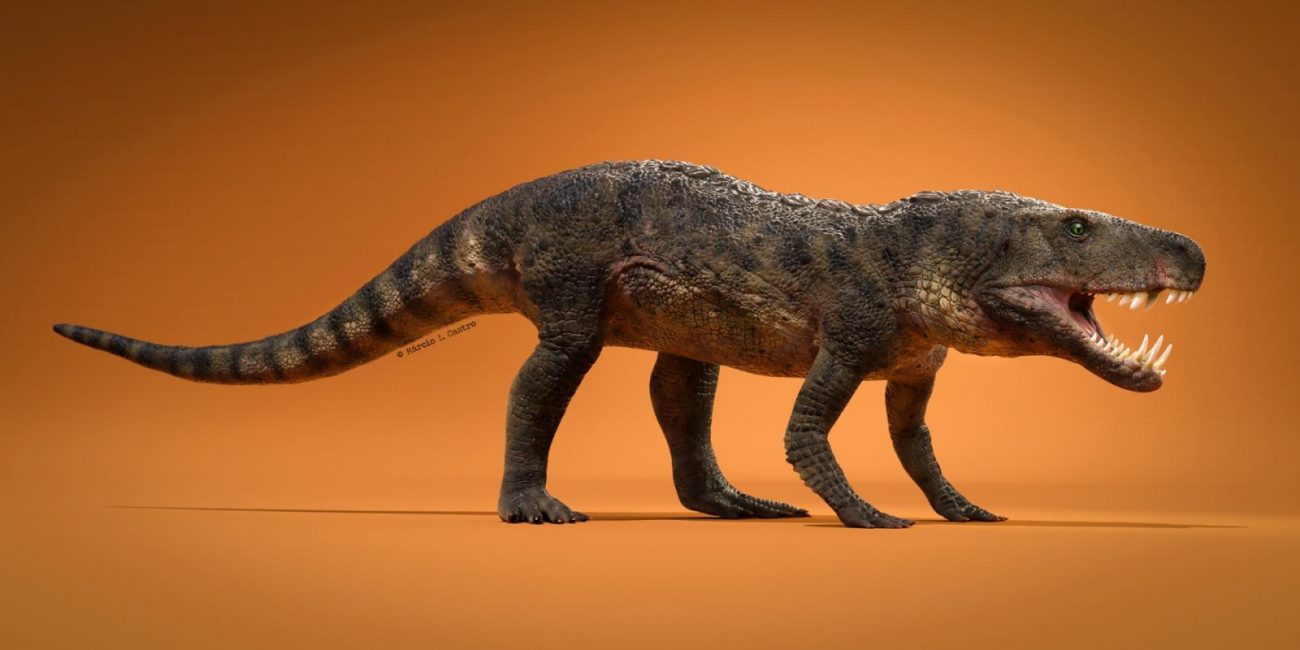
A series of Dimetrodon footprints found in May in P.E.I. National Park near Cavendishhave been confirmed as those of the sail-backed Bathygnathus borealis , more commonly known as dimetrodon.
Laura MacNeil,who has a background in geology,discovered the footprints while searching for fossils inthe area.
It was about the size of my hand and it almost looked like a human hand, but if the thumb were replaced with another digit, she said.
I looked at it for about a half an hour trying to convince myself that this wasnt a fossil because when youre in science, you try to be skeptical because you dont want to just jump to conclusions.
The footprints are of creatures that were living
MacNeilsaid she ran back to her car to call thethe province who then called Parks Canada andDr. JohnCalder, a geologistat Saint Marys University, to confirm what the discovery was.
My jaw was open for quite a long time. I couldntbelieve it, honestly, she said.

Calder said the footprintsbelonged to a dimetrodon,a mammal-like reptilethat lived 100 million years before the dinosaurs.
Its the first example from P.E.I. of this type of footprint, he said.
This isnt the first time a dimetrodonfossil has been found on P.E.I.
The fossil record on P.E.I. is truly world class
In 1845, the upper jaw bone of a dimetrodonwas discovered by a farmer duringa well excavationin French River, near the Islands North Shore.
Caldersaid thediscovery of the footprint is especially significant.

The bonesare of dead creatures, the footprints are of creatures that were living, he said.
When you see a fossil footprint, its a living fossil and it shows this animal actually walked here,this is how it stepped, this is where it walked.
Dimetrodonsarehuge, ancient reptiles that had giant spiny sails on their backs.
They ate giant salamanders in the steamy, swampy forests of the early Permian period, around 290 million years ago.
Rich prehistoric history
Although fossils are scattered in various places across the Island, Calder said these particular footprints are important as they indicate that P.E.I. holds some of Canadas richest evidence of terrestrial fossils of the Permian period.
Their fossils have previously been found in Germany and the United States.
The fossil record on P.E.I. is truly world class and yet most people dont even know about it,saidCalder.
MacNeilsaid the fossil will be studied by scientists andhopefully put on display at P.E.I.s national park this summer.
Also read: Fossils of Lion larger than a polar bear discovered in Kenya
Source:www.cbc.ca