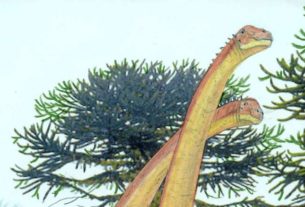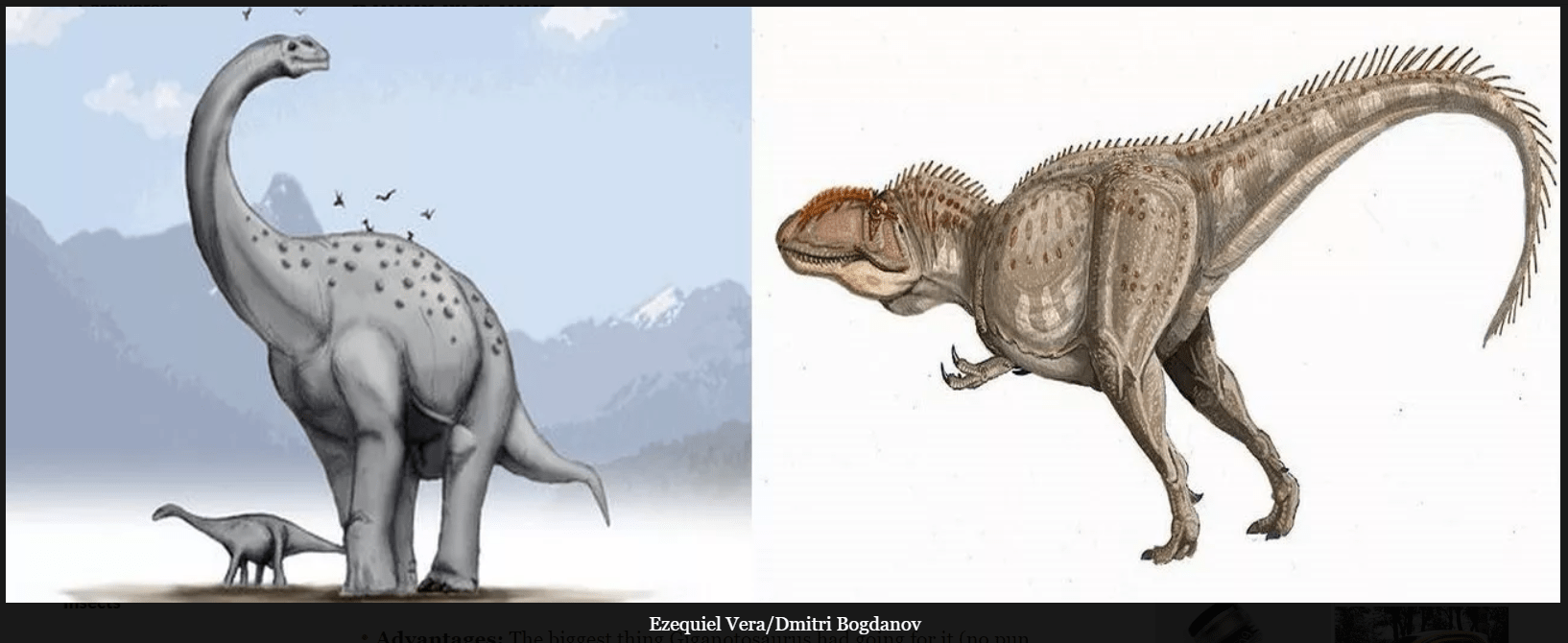
About 100 million years ago, during the middle Cretaceous period, the continent of South America was home to both Argentinosaurus , at up to 100 tons and over 100 feet from head to tail, probably the biggest dinosaur that ever lived, and the T.-Rex sized Giganotosaurus ; in fact, these dinosaurs fossilized remains have been discovered in close proximity to each other. Its possible that hungry packs of Giganotosaurus occasionally took on a full-grown Argentinosaurus; the question is, who came out on top in this clash of giants?
In the Near Corner: Giganotosaurus, the Middle Cretaceous Killing Machine

Giganotosaurus, the Giant Southern Lizard, is a relatively recent addition to the dinosaur pantheon; the fossilized remains of this carnivore were only discovered in 1987. Roughly the same size as Tyrannosaurus Rex , about 40 feet from head to tail, fully grown, and weighing in the neighborhood of seven or eight tons, Giganotosaurus bore a striking resemblance to its more famous cousin, albeit with a narrower skull, longer arms, and a slightly smaller brain relative to its body size.
- Advantages: The biggest thing Giganotosaurus had going for it (no pun intended) was its enormous size, which made it more than a match for the massive, plant-eating titanosaurs of Middle Cretaceous South America. While they were relativelypuny compared to those of comparably sized theropods, this dinosaurs nimble, three-clawed hands would have been lethal in close-quarters combat, and like T. Rex it possessed an excellent sense of smell. Also, to judge by the associated remains of other carcharodontid dinosaurs, Giganotosaurus may have hunted in packs, an essential prerequisite for attacking a full-grown Argentinosaurus.
- Disadvantages: According to a recent analysis of Giganotosaurus skull, this dinosaur chomped down on its prey with barely one-third the pounds of force per square inch of Tyrannosaurus Rexnothing to be sneezed at, but nothing that would be invariably fatal, either. Rather than delivering a single killing blow, it seems, Giganotosaurus used its sharp bottom teeth to inflict a succession of slicing wounds, in the course of which its unfortunate victim slowly bled to death. And did we mention Giganotosaurus below-average-sized brain ?
In the Far Corner: Argentinosaurus, the Skyscraper-Sized Titanosaur
Like Giganotosaurus, Argentinosaurus is a relative newcomer to the dinosaur world, especially compared to venerable sauropods like Diplodocus and Brachiosaurus . The type fossil of this enormous plant-muncher was discovered by the famous paleontologist Jose F. Bonaparte in 1993, whereupon Argentinosaurus immediately assumed its position as one of the biggest dinosaurs that ever lived (though there are tantalizing hints that other South American titanosaurs, likeBruhathkayosaurus, may have been even bigger, and new candidates are being discovered practically every year).
- Advantages: Boy, did Giganotosaurus and Argentinosaurus have a lot in common. Just as the nine-ton Giganotosaurus was the apex predator of its lush habitat, so a full-grown Argentinosaurus was, literally, the king of the mountain. Some Argentinosaurus individuals may have measured over 100 feet from head to tail and weighed north of 100 tons. Not only did the sheer size and bulk of a full-grown Argentinosaurus make it virtually immune to predation, but this dinosaur may also have flicked its long, whip-like tail to inflict supersonic (and potentially lethal) wounds on pesky predators.
- Disadvantages: How fast could a 100-ton Argentinosauruspossibly have run, even if its life was in imminent danger? The logical answer is, not very. Plus, the plant-eating dinosaurs of the Mesozoic Era werent notable for their exceptionally high IQs; the fact is that a titanosaur like Argentinosaurus needed to be only slightly smarter than the trees and ferns it munched on, which would make it no mental match even for the comparatively dimwitted Giganotosaurus. Theres also the question of reflexes; just how long did it take for a nerve signal from Argentinosaurus tail to make its way to this dinosaurs tiny brain?
Fight
Theres no way even the hungriest Giganotosaurus would have been foolhardy enough to attack a full-grown Argentinosaurus; so lets say, for the sake of argument, that an impromptu pack of three adultshasteamed up for the job. One individual aims for the base of Argentinosaurus long neck, while the other two butt into the titanosaurs flank simultaneously, attempting to knock it off balance. Unfortunately, even 25 or 30 tons of combined force isnt enough to dislodge a 100-ton obstacle, and the Giganotosaurus closest to Argentinosaurus rump has left itself wide open to a supersonic tail flick to the head, rendering it unconscious. Of the two remaining meat-eaters, one has been left dangling almost comically off Argentinosaurus elongated neck, while the other savagely inflicts grotesque-looking, but mostly superficial, wounds under this titanosaurs massive belly.
And the Winner Is
Argentinosaurus: Theres a reason evolution favoredgigantismin dinosaurs like Argentinosaurus; out of a clutch of 15 or 20 hatchlings, only one needed to attain full maturity in order to perpetuate the breed, while the other babies and juveniles were hunted down by hungry theropods. If our Giganotosaurus pack had targeted a recently hatched Argentinosaurus rather than a full-grown adult, it might have been successful in its quest. As it is, though, the predators fall back warily and allow the wounded Argentinosaurus to walk slowly away, and thenproceed to devour their fallen comrade.
Source: thoughtco.com