Cotylorhynchus
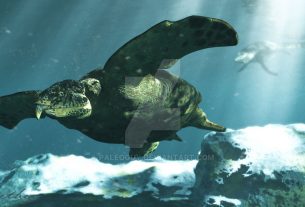
Cotylorhynchus is an extinct genus of very largesynapsidsthat lived in the southern part of what is nowNorth Americaduring theEarly Permian period.It is the best known member of the synapsid cladeCaseidae, usually considered the largest terrestrial vertebrates of the Early Permian,though they were possibly aquatic.
Cotylorhynchus was a heavily built animal with a disproportionately small head and a huge barrel-shaped body. Adults of the species C. romeri were about 3m (9.8ft)while those of the younger C. hancocki were around 20-25% larger in linear measurements,making it one of the largestsynapsids of the earlyPermian.

            Mounted skeleton of

             C. romeri
Their skulls are distinctive in the presence of largetemporal openingsand very large nostril openings, which could have been utilized for betterbreathingor may have housed some sort ofsensoryor moisture conserving organ. Also they featured largepineal openingsand a snout or upper jaw that overhangs the row of teeth to form a projectingrostrum. Rounded deep pits and possibly large depressions were present on the outer surface of the skull. Their teeth were very similar to those ofiguanas with posterior marginal teeth that bore a longitudinal row ofcusps.
Theirskeletalfeatures included a massivescapulocoracoid, humeri with large flared ends, stout forearm bones and broad, robust hands that had large claws. Certain features of their hands indicate that they were paddle-like in shape and structure, being used to swim in a manner much similar to that of modern turtles.
Their digits were believed to have a considerable range of motion and large retractor processes on theventralsurfaces of theungualsallowed them to flex their claws with powerful motions. Also, the articulatory surfaces of theirphalangeswere oblique to the bones long axis rather than perpendicular to it. This allowed for much more surface area for the flexor muscles.
Cotylorhynchus branson

Size comparison
Cotylorhynchus shows evidence indicative of a diaphragm. Unlike that of modern mammals it was probably weak and necessitating support from other muscle groups, a deficiency exacerbated by its aquatic habits.
Cotylorhynchus were considered a part of the first wave ofamniote diversity. There have been three species of Cotylorhynchus discovered: C. hancocki , C. romeri and C. bransoni . C. hancocki is believed to be a descendant of the slightly smaller C. romeri .
- Various skeletal parts of C. romeri have been found around central Oklahoma in parts ofCleveland County.
- Parts of C. hancocki have been found in northernTexasinHardeman andKnoxcounties.
- C. bransoni specimens have been uncovered inKingfisherandBlaine Counties of central-northwest Oklahoma.
Cotylorhynchus belongs to the familyCaseidae, a family of massively builtsynapsidswith small heads and barrel-like bodies. It was a derived member ofCaseidae. It is asister taxonof Angelosaurus .
Source: wikipedia
Also read: Prehistoric Creatures